← Back to The Land of Enlightenment
Bodh Gaya

Bodh Gaya

Where Siddhartha Gautama attained enlightenment beneath the Bodhi Tree.

Bodh Gaya

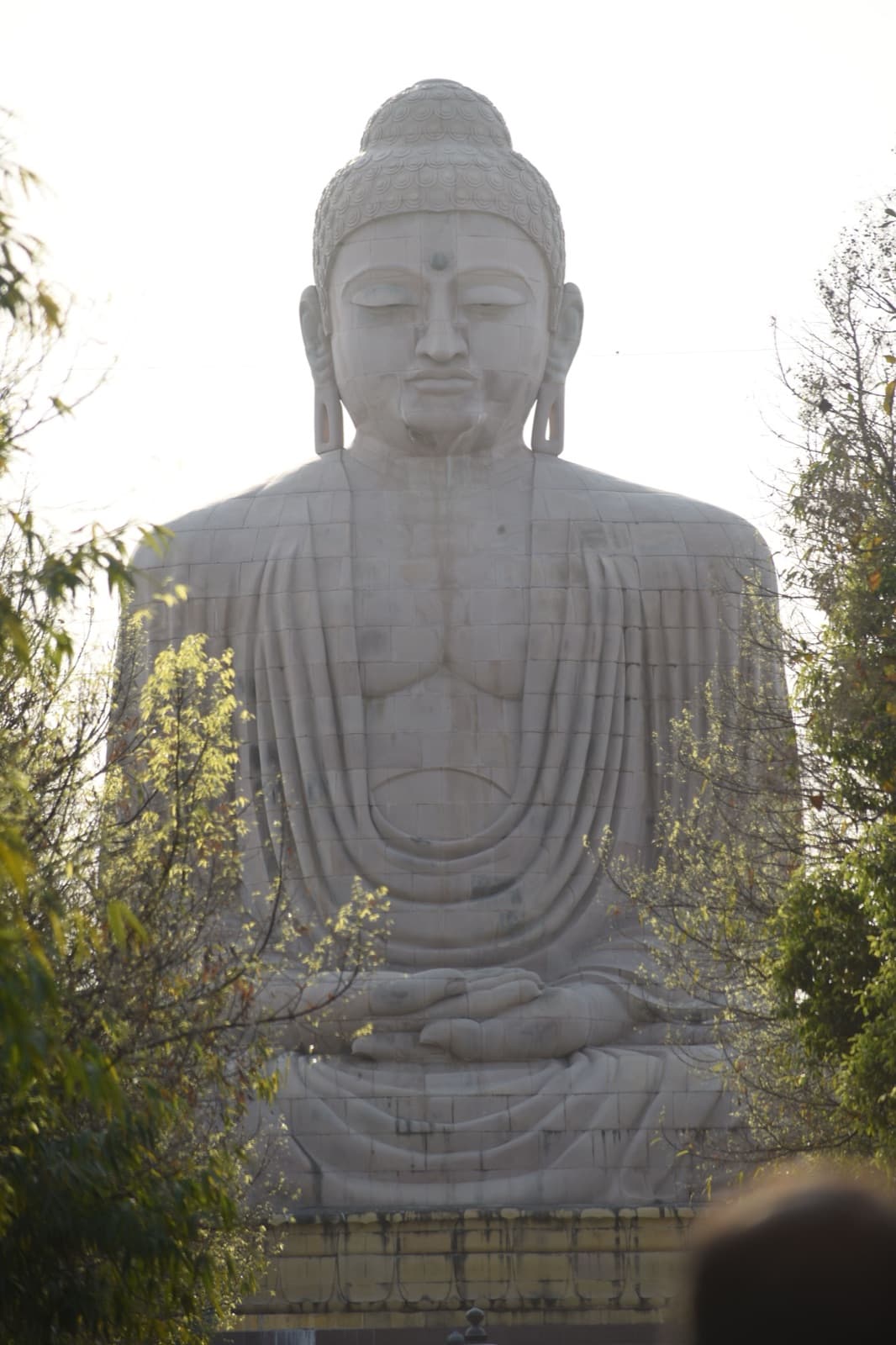
A closer look — Ken Wieland, Wikimedia Commons (CC BY-SA 2.0)

Nearest airport
Gaya Airport (Bodhgaya International Airport) (GAY)
about 13 km from the Mahabodhi Temple

Getting there

By air
Gaya Airport (Bodhgaya International Airport) (GAY)

about 13 km from the Mahabodhi Temple

By rail
Gaya Junction

About 13 to 16 km from the temple, 25 to 30 minutes by road. The main railhead for the whole Bodh Gaya/Rajgir/Nalanda cluster, with direct trains from Delhi, Kolkata, Varanasi and Patna.

By road

On NH83, connecting onward to Rajgir and, further out, to Patna and Varanasi.

On this circuit: Alternate start of the Land of Enlightenment circuit (fly into Gaya, out via Patna). Reached from Patna: about 101 km, roughly 2.5 to 3 hours by road. Onward to Rajgir: about 57 km by road.

Stories about this place

A Note on This Story

Our interpretation, not a single fixed account

This narrative follows the traditional account of the Buddha's awakening at Bodh Gaya, as told across the Pali Canon and the later commentarial biographies: the Nidanakatha that introduces the Jataka collection, Ashvaghosha's Buddhacarita, and the Lalitavistara Sutra of the Mahayana tradition. These sources do not always agree on sequence or detail, and different Buddhist traditions emphasize different episodes. What follows presents the major events as one connected story, distinguishing clearly between what tradition narrates (Mara's assault, the deities' involvement) and what is independently documented history (the tree's physical lineage, the temple's construction).

Source: BuddhaNet

I. The Prince Who Left the Palace

Local tradition, passed down but not formally documented

Before he was the Buddha, he was Siddhartha Gautama, a prince of the Shakya clan, raised in comfort and shielded from suffering. Tradition holds that four sights broke through that shelter: an old man, a sick man, a corpse, and finally a wandering ascetic at peace despite having nothing. Confronted with age, illness and death, and struck by the ascetic's stillness, Siddhartha left his palace, his wife and his infant son in the night, in what is remembered as the Great Departure.

He spent years afterward studying under renowned teachers of meditation, mastering what they taught yet finding it fell short of what he was searching for. He turned, as many seekers of his age did, toward extreme self-denial.

Source: BuddhaNet

II. Six Years of Austerity

Local tradition, passed down but not formally documented

For six years, Siddhartha practiced extreme asceticism alongside five companions, testing how far the body could be denied in pursuit of liberation. Tradition describes him eating as little as a single grain of rice a day, his body wasting until, by his own later account, he could feel his spine through his stomach when he touched it.

He nearly died without arriving at the understanding he sought. The realization that eventually turned him away from this path was simple and hard-won: punishing the body did not free the mind. Something else was needed.

Source: BuddhaNet

III. The Middle Way

Local tradition, passed down but not formally documented

Siddhartha accepted a bowl of milk-rice from Sujata, a village woman, breaking his fast. His five companions, believing he had abandoned the path, left him in disappointment.

Alone now, he had found the outline of what would become central to his teaching: a Middle Way between indulgence and self-mortification, neither of which alone could lead to awakening. Nourished, he turned toward the Neranjana River, toward the tree under which he would not rise again until he understood.

Source: BuddhaNet

IV. The Seat Beneath the Tree

Local tradition, passed down but not formally documented

On the bank of the Neranjana, tradition tells of a grass-cutter named Sotthiya who offered Siddhartha bundles of soft grass for a seat. He arranged it beneath a large pipal tree (the tree that would come to be called the Bodhi Tree, the tree of awakening), facing east, and sat down with a resolve remembered in Buddhist tradition in something like these terms: that his skin, sinews and bones might dry up, and his flesh and blood wither away, but he would not rise from that seat until he had attained full awakening.

Source: BuddhaNet

V. Mara's Assault

Traditional story, not verified history

Mara, in Buddhist tradition the personification of death, delusion and every force that keeps beings bound to craving, could not allow this. He sent armies of demons to terrify Siddhartha from his seat, and when violence failed, he sent his daughters, Tanha, Arati and Raga, craving, aversion and desire, to seduce him from it. Neither moved him.

Mara then challenged Siddhartha's very right to the seat itself, boasting of his own spiritual merit and demanding witnesses to it. Siddhartha had none present to call, until he reached down and touched the earth with his right hand. In the gesture known ever since as bhumisparsha, the earth-witness, he called the ground itself to testify to lifetimes of virtue behind him. Tradition holds that the earth answered, and Mara's armies fled.

Source: BuddhaNet

VI. The Night of Awakening

Local tradition, passed down but not formally documented

With Mara gone, Siddhartha's mind settled into a depth of concentration tradition divides into three watches of the night. In the first watch, he recollected his own countless past lives, one after another. In the second, he saw with what is called the divine eye how all beings pass from death to rebirth according to their actions.

In the third watch, before dawn, he saw the Four Noble Truths directly: the nature of suffering, its cause, its cessation, and the path to that cessation. With that seeing, the last defilements of the mind fell away. As the morning star rose, Siddhartha Gautama became the Buddha, the Awakened One, at around thirty-five years of age.

Source: BuddhaNet

VII. Seven Weeks Beside the Tree

Local tradition, passed down but not formally documented

Tradition holds that the Buddha remained near the Bodhi Tree for seven weeks after his awakening, not yet teaching, simply abiding in what he had found. In the second week he is said to have stood gazing at the tree without blinking, in gratitude. In the third, he paced a jewelled walk that tradition says appeared beneath his feet. In the sixth week, when a storm broke, the serpent king Muchalinda is said to have risen from the earth and wound his hood over the Buddha to shelter him from the rain, unwinding only once the sky cleared.

At the close of the seventh week, seated beneath the Rajayatana tree, two passing merchants, Tapussa and Bhallika, offered him rice and honey cakes, his first meal since his awakening, and are remembered as his first lay disciples.

Source: Vipassana Research Institute

VIII. The Decision to Teach

Local tradition, passed down but not formally documented

What the Buddha had understood, tradition says, felt too subtle and too contrary to worldly craving for most people to grasp, and he considered remaining silent. It is said that Brahma Sahampati, a great divine being, came before him and asked him to teach anyway, for the sake of those with, as the tradition puts it, little dust in their eyes, who would understand if only someone showed them.

Moved by this appeal, the Buddha agreed. He set out for Sarnath, near Varanasi, to find the five companions who had left him, and there, in the Deer Park, gave his first teaching: the Four Noble Truths and the Eightfold Path, remembered as the turning of the Wheel of Dharma.

Source: BuddhaNet

IX. The Bodhi Tree Through History

Historical record

Unlike the night beneath it, what happened to the tree itself afterward is real, documented history, not tradition. The Mauryan emperor Ashoka made a pilgrimage to Bodh Gaya in the 3rd century BCE, the first recorded royal visit to the site, and built a shrine around the tree. His daughter, the nun Sanghamitta, carried a cutting of it to Sri Lanka, where it was planted at Anuradhapura in 288 BCE. That tree, the Jaya Sri Maha Bodhi, still lives today and is the oldest human-planted tree in the world with a continuously documented planting date.

The original tree at Bodh Gaya did not survive intact. The Chinese pilgrim Xuanzang, visiting around 637 CE, recorded that the Bengal king Shashanka had cut it down and burned the stump roughly a generation earlier. A later storm destroyed the tree again in 1876. In 1881, the archaeologist Alexander Cunningham planted the tree that stands at Bodh Gaya today, grown from a cutting of the Anuradhapura tree, itself descended from the original. The circle closes on itself: the present tree at Bodh Gaya is a returned descendant of the cutting Ashoka's own daughter carried away twenty-two centuries earlier.

Source: Wikipedia, Bodhi Tree

X. The Mahabodhi Temple's Real History

Verified fact

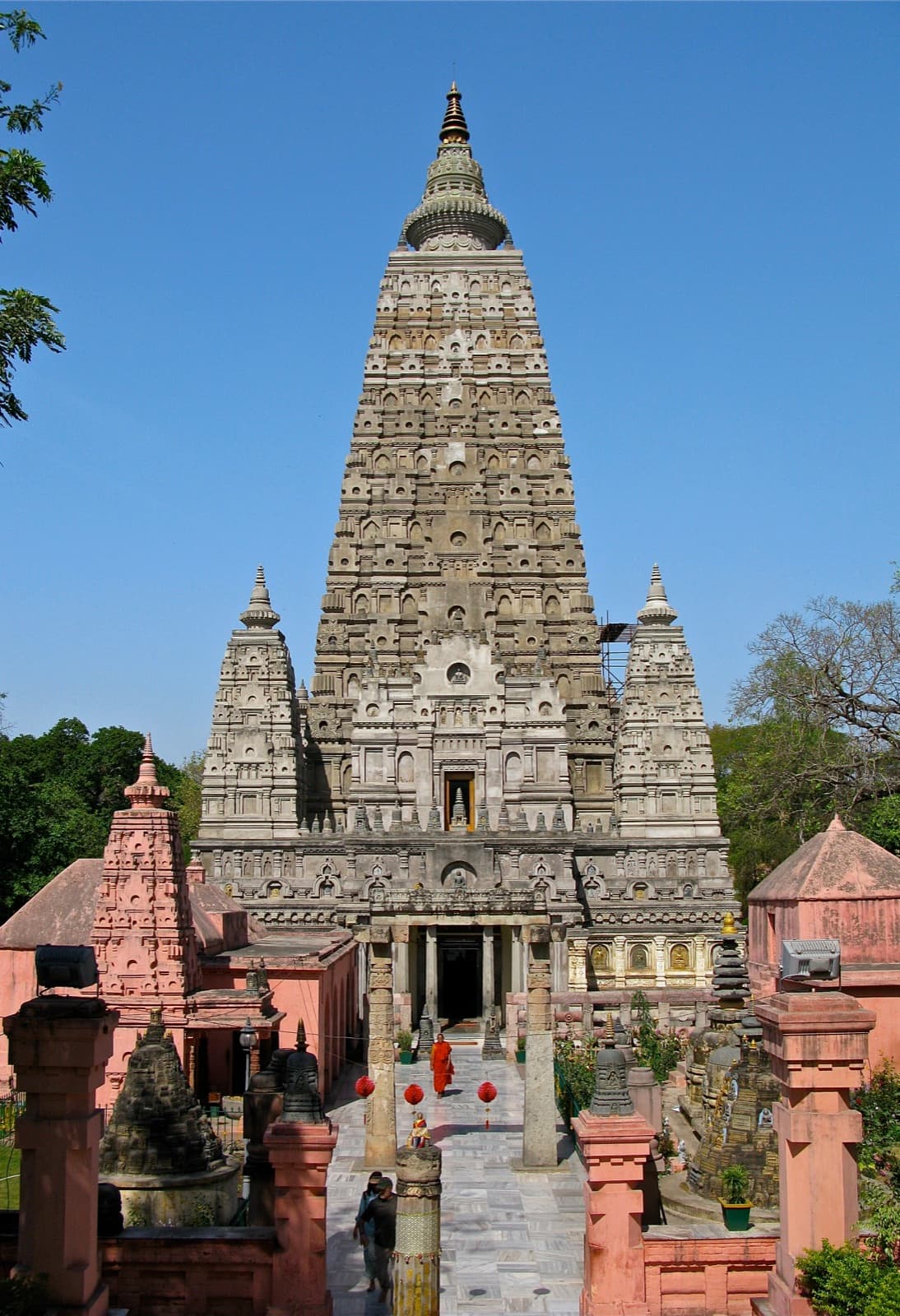
The shrine Ashoka built at the tree in the 3rd century BCE was not the temple that stands today. The present brick structure dates largely to the 5th-6th century CE, in the Gupta architectural style, with a pyramidal spire rising to roughly 55 metres, among the earliest and most imposing structures built entirely in brick to survive from that period in India. The Mahabodhi Temple Complex, covering 4.86 hectares, was inscribed as a UNESCO World Heritage Site in June 2002.

Source: Ministry of Culture, Government of India

Epilogue: What the Awakening Means

Our interpretation, not a single fixed account

The story of the awakening can be read as a single arc. The six years of austerity represent the limits of self-denial alone. Sujata's offering and the Middle Way represent balance over extremity. Mara represents every inner obstacle (fear, desire, doubt) that rises just before a true change of understanding. The earth-witness gesture represents the weight of one's own past conduct as its own testimony, needing no other witness. The seven weeks represent gratitude and hesitation both, even after the goal is reached. Brahma's request represents compassion overriding the temptation to keep hard-won understanding to oneself.

Twenty-five centuries later, the tree that stands at Bodh Gaya is not the original, and tradition would say that misses the point. What the story asks of anyone who hears it is not to verify a lineage of cuttings, but to sit, as Siddhartha did, with whatever is actually true, until it becomes impossible to look away from.

Ancient: Part of Magadha

Historical record

Bodh Gaya lies within the historical region of Magadha, the same kingdom whose capitals at Rajagriha and later Pataliputra dominated much of the Buddha's own lifetime and the centuries that followed.

13th to 19th century: Centuries of dormancy

Historical record

Following the broader decline of Buddhism in India, the town's Buddhist institutions fell largely dormant for several centuries, alongside the Mahabodhi Temple itself.

Late 19th century onward: International Buddhist revival

Historical record

Renewed international Buddhist interest, especially from Sri Lanka, Myanmar, Thailand, Japan, Tibet and Bhutan, led to national monasteries being built in the town from the late 19th century onward, alongside Alexander Cunningham's archaeological restoration of the temple.

2002: UNESCO listing brings wider attention

Verified fact

The Mahabodhi Temple Complex's UNESCO World Heritage inscription drew further international attention and pilgrimage traffic to the town.

3rd century BCE: Ashoka's original shrine

Historical record

Emperor Ashoka built a shrine at the site to mark the place of the Buddha's enlightenment, the origin of the Mahabodhi Temple.

Source: New World Encyclopedia, Mahabodhi Temple

c. 5th to 6th century CE: The present structure built

Historical record

The temple's present pyramidal brick structure was largely built in this period, in the Gupta architectural style.

13th to 19th century: Abandoned and left to disrepair

Historical record

Following the decline of Buddhism in India and the wider destruction of Buddhist institutions in the region, the temple was largely abandoned as an active Buddhist site for centuries.

Source: newslaundry.com, Tracing the Bodh Gaya temple conflict

16th century onward: A Hindu math established nearby

Historical record

A Hindu monastery (math) was established near the temple. Over the following centuries its abbot, the mahant, became the area's dominant landholder and claimed ownership of the temple grounds.

Source: ThePrint, Who owns Mahabodhi Temple? Bodh Gaya's Buddhist-Brahmin dispute

1880s: Cunningham's restoration

Historical record

Alexander Cunningham, founder of the Archaeological Survey of India, led a major restoration of the then-dilapidated temple.

1891: Dharmapala's campaign begins

Historical record

The Sri Lankan Buddhist reformer Anagarika Dharmapala began a campaign to return control of the temple to Buddhists, opposed by the mahant. This question of who controls the temple, not its physical structure, has continued in various forms ever since.

2002: UNESCO World Heritage listing

Verified fact

The Mahabodhi Temple Complex was inscribed as a UNESCO World Heritage Site.

1949: The Bodh Gaya Temple Act

Verified fact

Bihar's state legislature passed the Bodh Gaya Temple Act, creating an eight-member management committee evenly split between Hindus and Buddhists, chaired ex officio by the Gaya district magistrate, ending direct mahant control of the temple.

Source: Wikipedia, Bodh Gaya Temple Act, 1949

1953: Management transferred

Verified fact

Management of the temple formally passed from the mahant to the new committee.

Since 1949: Ongoing Buddhist calls for repeal

Verified fact

Buddhist organisations have periodically renewed calls for the Act's repeal, seeking exclusive Buddhist management of a site central to their faith, and arguing that a temple of unique significance to world Buddhism should not have its management legally guaranteed to include non-Buddhist members.

12 Feb 2025 onward: Indefinite protest for repeal

Verified fact

Buddhist monks under the All India Buddhist Forum began an indefinite protest at Bodh Gaya demanding the Act's repeal and full transfer of management to the Buddhist community. The protest continued for many months through 2025 and drew political attention, including a repeal pledge from Bihar's opposition alliance.

Source: Al Jazeera, Buddhism's holiest site erupts in protests over Hindu control of shrine

Festivals & best time to visit

Best time to visit: October to March, especially November to February, with daytime temperatures around 20 to 28°C and cool, foggy nights. March to June turns extremely hot, up to 45°C.

Buddha Purnima (Vesak)

Next: 20 May 2027

Marks the Buddha's birth, enlightenment and death together, on the full moon of Vaishakha: the single most important day at the Mahabodhi Temple, with chanting, processions and the temple's largest pilgrim gathering of the year. Falls in the hot, pre-monsoon season, so plan for the heat.

Kalachakra teachings

Irregular, usually a winter visit (Dec to Jan) when scheduled

When the Dalai Lama visits Bodh Gaya's dedicated Kalachakra Ground, usually in winter, tens of thousands of monks, nuns and pilgrims from across the Himalayan Buddhist world gather for public teachings and, periodically, a full multi-day Kalachakra initiation. Not an annual fixed-calendar event; check current-year announcements before planning a trip around it.

Where to stay

Real, independently sourced hotels - see each listing's source link. Booking here is a demo reservation, not a real payment or confirmed room.

Luxury
Bodh Gaya simply doesn't have a verified 4+-rated hotel consistently priced ₹8,000+ yet - its best-reviewed property, Marasa Sarovar Premiere (below), tops out around ₹5,800/night. A real market gap versus Varanasi, Ayodhya or Patna, not something to force. (A separately-found lead, a hotel calling itself "Taj Bodh Gaya", turned out on closer checking to be an unrelated 3-star budget property with no real Taj/IHCL affiliation - discarded rather than used.)
Standard
₹5,800–₹6,770
Budget
₹1,400–₹3,000