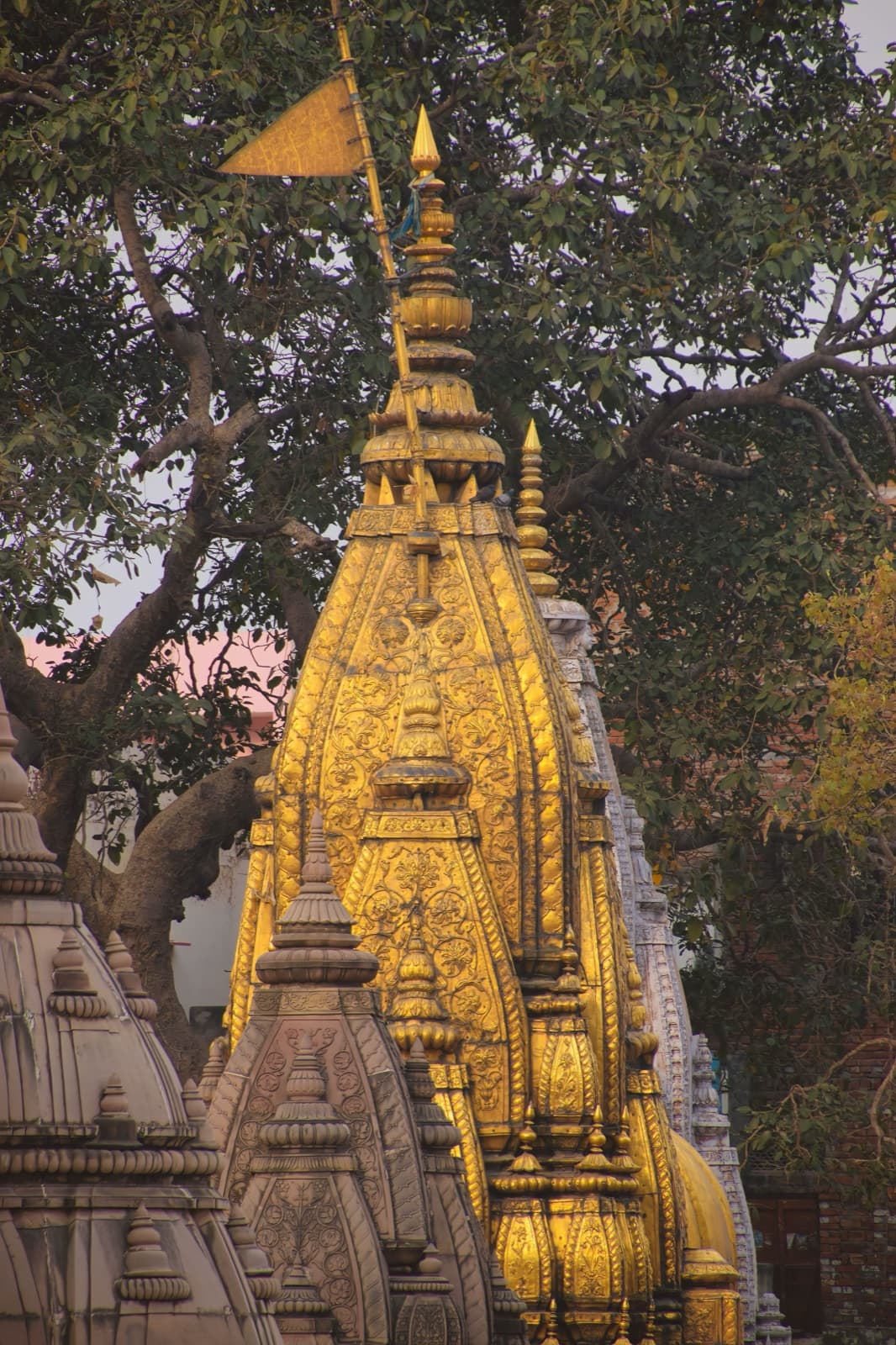
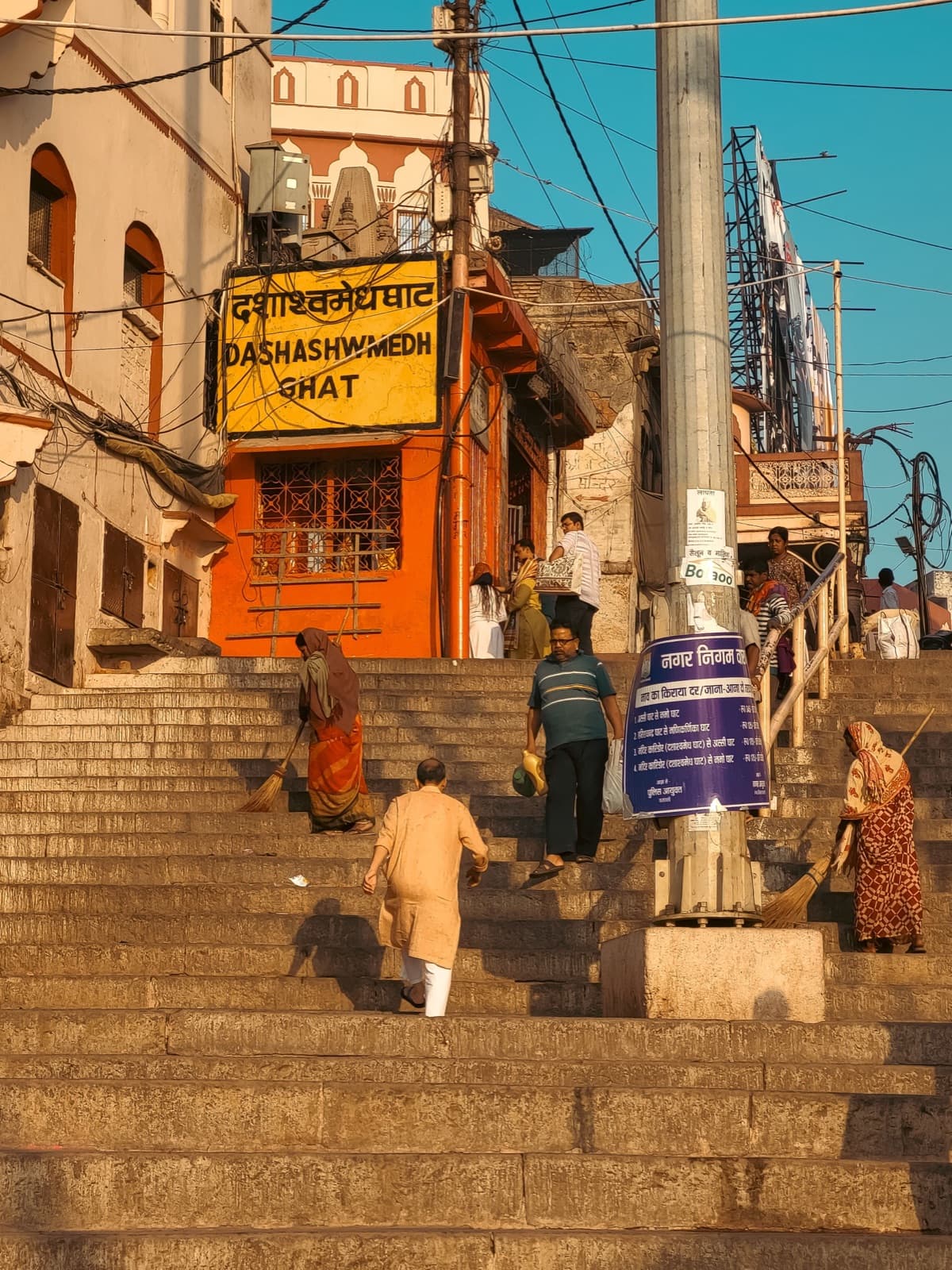
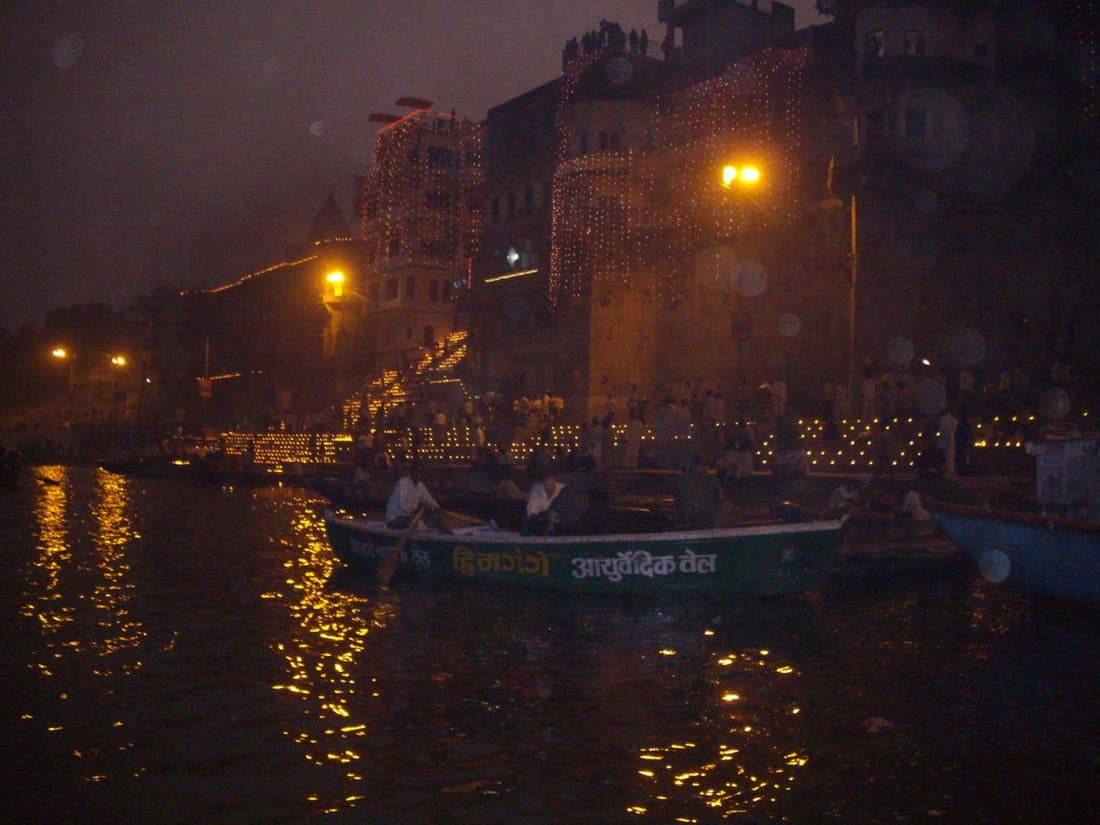
The City of Light, Shiva's Avimukta, the ghats, and the Ganga.
Stories about this place
A Note on This Story
Our interpretation, not a single fixed accountThis narrative is a literary retelling of the mythology associated with Kashi, drawing particularly on the Kashi Khanda of the Skanda Purana and related Hindu sacred traditions. The Kashi Khanda itself runs to some 100 chapters and roughly 12,000 verses, and is a religious text containing multiple layers of legend, theology and pilgrimage tradition. Different lineages and regions sometimes tell individual episodes differently. What follows presents the major stories as one connected sacred narrative, rather than claiming a single universally accepted version.
Source: Wisdom Library, Skanda Purana (Kashi Khanda)
Prologue: Before the City
Traditional story, not verified historyBefore kings, before empires, before the great cities of India, there was the mystery of creation. The gods themselves were part of a universe governed by cycles of creation and dissolution. Yet beyond these cycles stood Shiva: the ascetic, the lord of consciousness, at once utterly still and the cosmic dancer.
Among the sacred places of the earth was a field that would become Kashi. Its name is traditionally connected with the Sanskrit root kāś, 'to shine.' Kashi therefore came to be understood as the City of Light, a place where ignorance could be dispelled and the highest truth revealed.
Source: Wisdom Library, Skanda Purana (Kashi Khanda)
I. Shiva Chooses Kashi
Traditional story, not verified historyThe sacred traditions describe Kashi as Avimukta, the place never forsaken by Shiva. In the mythology of the city, Shiva does not merely visit Kashi; he establishes his presence there as Vishwanath, Lord of the Universe.
The city becomes a sacred field where ordinary geography meets sacred geography. A river becomes more than a river, a temple becomes more than a building, and death itself becomes a doorway to spiritual liberation.
Source: Wisdom Library, Skanda Purana (Kashi Khanda)
II. Parvati Asks for a Home
Traditional story, not verified historyParvati, the divine feminine power and companion of Shiva, is central to the mythology of Kashi. In one strand of tradition, the divine couple seeks a place to establish their household, and Kashi becomes their sacred home.
Shiva manifests as Kashi Vishwanath. Parvati manifests in nourishing and protective forms. The city becomes a place where Shiva and Shakti are understood together: consciousness and energy, stillness and creation.
Source: Wisdom Library, Skanda Purana (Kashi Khanda)
III. The City Upon the Trident
Traditional story, not verified historyOne of the most enduring images in Kashi's mythology is that the sacred city rests upon Shiva's trident, the Trishula. The image is theological rather than geographical: the world is subject to time, change and cosmic dissolution, while Kashi is portrayed as belonging to the realm of the eternal.
When the universe is dissolved, tradition says Shiva preserves Kashi. So the city is called Avimukta: never abandoned, never spiritually lost.
Source: Wisdom Library, Skanda Purana (Kashi Khanda)
IV. The Coming of Ganga
Traditional story, not verified historyFar away, King Bhagiratha performs severe austerities to bring the celestial Ganga down to earth so his ancestors' souls may be liberated. Ganga agrees to descend, but her force is so immense the earth cannot receive her directly.
Bhagiratha turns to Shiva. Shiva catches Ganga in his matted hair, breaking the force of her descent and allowing her waters to flow gradually onto the earth. Ganga then begins her journey across India.
At Kashi, the river and Shiva become inseparable symbols. Ganga purifies; Shiva liberates. One cleanses the journey of life, while the other points beyond the cycle of birth and death.
Source: Wisdom Library, Skanda Purana (Kashi Khanda)
V. Divodasa and the Empty Throne
Traditional story, not verified historyThe Kashi Khanda contains a major cycle of stories concerning King Divodasa. In this telling, the gods and divine powers are not simply installed in the city from the beginning. A human ruler is given responsibility for Kashi, and Shiva's direct presence becomes the subject of a great divine drama.
Divodasa is portrayed as an exceptionally capable and righteous king. Yet the arrangement creates a problem: Kashi, the city Shiva desires as his home, is being governed under a different order. The gods attempt different means of bringing Divodasa toward the divine order, and the story unfolds through a sequence of visits, tests and transformations. Eventually the conditions keeping Shiva away from Kashi begin to disappear.
The deeper meaning is that the city cannot remain spiritually complete without the return of its Lord. Kashi's sacred identity is fulfilled when Vishwanath is established again at its heart.
Source: Wisdom Library, Skanda Purana (Kashi Khanda)
VI. Vishwanath, Lord of the Universe
Traditional story, not verified historyShiva's principal identity in Kashi is Vishwanath, 'Lord of the Universe.' The Vishwanath tradition is associated with the Jyotirlinga concept: Shiva as an infinite pillar or column of divine light, beyond beginning and end.
The famous Jyotirlinga story tells of Brahma and Vishnu searching for the limits of Shiva's manifestation as an infinite column of light. Neither can find its beginning or end. The story teaches that ultimate reality cannot be reduced to ordinary measures.
Source: Wisdom Library, Skanda Purana (Kashi Khanda)
VII. Manikarnika: Where Life Meets Death
Traditional story, not verified historyNear the Ganga is Manikarnika, one of the most sacred and symbolically powerful places in Kashi. Its name is traditionally associated with a jewel and an ear ornament, and several versions of its origin circulate in the sacred literature.
One tradition connects the place with Vishnu's austerities and a sacred pond. Another tells of Parvati's jeweled ear ornament falling there. The details differ, but the sacred meaning is consistent: Manikarnika becomes a place where the distinction between worldly life and spiritual liberation is especially thin.
Source: Wisdom Library, Skanda Purana (Kashi Khanda)
VIII. Why Death in Kashi Is Sacred
Traditional story, not verified historyHindu thought often describes ordinary existence as samsara, the cycle of birth and death; moksha is liberation from that cycle. Kashi becomes one of the great sacred places associated with this liberation.
Tradition holds that Shiva grants the dying the liberating knowledge known as the Taraka Mantra, the mantra that carries the soul across. This is why the city has attracted pilgrims, ascetics and those approaching the end of life for centuries.
The cremation fires of Manikarnika therefore carry a meaning beyond mortality. They remind the pilgrim that the body is temporary while the search for the eternal continues.
Source: Wisdom Library, Skanda Purana (Kashi Khanda)
IX. Annapurna: When Shiva Asks for Food
Traditional story, not verified historyKashi's mythology is not only about death and transcendence. It is also about food, household life and nourishment.
In a famous story, Shiva declares the material world to be illusory. Parvati challenges the idea by withdrawing herself from the world; without the divine feminine power that sustains manifestation, food disappears and beings suffer.
Parvati returns as Annapurna, the goddess who gives food, and Shiva himself receives nourishment from her. The lesson is that spirit cannot simply reject the material world: consciousness and energy, Shiva and Shakti, belong together.
Source: Wisdom Library, Skanda Purana (Kashi Khanda)
X. Kal Bhairav, Guardian of Kashi
Traditional story, not verified historyKashi also has a fierce guardian: Kal Bhairav, a powerful manifestation of Shiva. In popular sacred tradition, Bhairav is the Kotwal, or guardian, of Kashi.
The symbolism is striking. Vishwanath is the Lord of the city; Annapurna nourishes it; Ganga purifies it; and Kal Bhairav protects its sacred boundaries.
Source: Wisdom Library, Skanda Purana (Kashi Khanda)
The Kaal Bhairav Temple Today
Verified factThe Shri Kaal Bhairav Temple stands in Bhatt ki Gali, Golghar, in Varanasi's old city, open daily from 5:00 AM to 9:30 PM. Its silver-faced image of Kaal Bhairav is adorned with a garland of skulls; devotees purchase sacred threads (the Bhairav Raksha Sutra) at the site, with Tuesdays and Sundays the busiest days of worship.
Source: Kashi Official Web Portal, Shri Kaal Bhairav Temple
XI. The Ghats: A Sacred Stairway
Traditional story, not verified historyThe ghats of Kashi are not one single mythological creation. They are the accumulated sacred landscape of centuries. Each ghat carries its own legends, patrons, rituals and associations.
Dashashwamedh is associated in tradition with the performance of ten horse sacrifices. Assi is linked with the confluence of the Assi stream and the Ganga, and with later devotional traditions. Manikarnika is associated with cremation and liberation. Other ghats carry stories connected with kings, saints, temples and regional traditions.
Together they form a remarkable sacred theatre: bathing, prayer, music, pilgrimage, cremation and everyday life occur within the same landscape.
Source: Wisdom Library, Skanda Purana (Kashi Khanda)
Durga, Shumbha-Nishumbha and the Birth of Assi
Traditional story, not verified historyThe Devi Mahatmya builds toward its climax through a sequence of battles. The goddess first defeats the generals Chanda and Munda, sent against her with a vast army. Then comes Raktabija, whose every drop of spilled blood springs up as a fresh copy of himself the instant it touches the ground: a demon that cannot be defeated by wounding alone. Only after Raktabija falls does the goddess face the brothers Shumbha and Nishumbha themselves, the last and greatest of her adversaries.
Local Kashi tradition ties this victory directly to the city's southern boundary. After slaying Shumbha and Nishumbha, the goddess is said to have come to the bank of the Ganga and set down her sword. Where it struck the ground, tradition holds, a stream broke through the earth: the Assi, whose name is traditionally read as a form of asi, the Sanskrit word for sword. The ghat where the Assi meets the Ganga takes its name, and its sanctity, from this act.
Source: Kashi Official Web Portal, Assi Ghat
XII. Assi and the Sacred Southern Boundary
Traditional story, not verified historyThe southern sacred boundary of Kashi is traditionally associated with the Assi. The area later became particularly important in devotional and literary traditions, and is strongly associated with Tulsidas and the Ramcharitmanas.
Source: Wisdom Library, Skanda Purana (Kashi Khanda)
XIII. Tulsidas and the Living Tradition
Historical recordCenturies after the older Puranic traditions, the poet Tulsidas became deeply associated with Kashi. His Ramcharitmanas made the story of Rama accessible to millions through the vernacular tradition.
This illustrates something essential about Kashi: its mythology did not stop in antiquity. New saints, poets, teachers and communities continued to add layers of meaning to the city. This is why this block is classified as history rather than myth: Tulsidas was a real person, not a legendary figure, even though the tradition he shaped now sits alongside the older Puranic stories.
XIV. The City That Refuses to End
Traditional story, not verified historyThe great Kashi myth is ultimately a story about time. Cities normally rise and disappear; dynasties come and go; temples are built and rebuilt; human beings are born and die.
But Kashi is imagined differently. It is Avimukta, never forsaken. It is the city held by Shiva. Its sacred river flows beside it. Its cremation fires burn at Manikarnika. Its bells sound at Vishwanath. Its guardian stands at Kal Bhairav. Its food is offered through Annapurna.
The physical city changes, but the myth insists the sacred Kashi remains.
Source: Wisdom Library, Skanda Purana (Kashi Khanda)
Epilogue: What Kashi Means
Our interpretation, not a single fixed accountThe mythology of Kashi can be read as a single spiritual journey. Ganga represents purification. Vishwanath represents the eternal divine presence. Annapurna represents nourishment and Shakti. Kal Bhairav represents protection and the power of time. Manikarnika represents mortality and the possibility of liberation. The ghats represent the meeting of ordinary life with sacred life. Kashi itself represents illumination: the movement from ignorance toward knowledge.
The deepest myth of Kashi is not simply that Shiva lives there. It is that Kashi is a place where the human being is invited to confront the greatest questions: Who am I? What survives death? What is eternal? What is illusion? What is liberation?
Kashi is the City of Light. In its mythology, Shiva does not merely rule the city. He reveals what lies beyond it.
Source: Wisdom Library, Skanda Purana (Kashi Khanda)
Ancient: Textual origins
Local tradition, passed down but not formally documentedA Vishweshwar (Vishwanath) shrine at Kashi is described in the Skanda Purana's Kashi Khanda and referenced in medieval travellers' accounts. Its exact founding date cannot be independently verified and is a matter of tradition rather than historical record.
Ancient-1194 CE: Adi Vishveshwar: the original shrine
Local tradition, passed down but not formally documented“Adi Vishveshwar” (Sanskrit adi, “first” or “original”) is the name by which the earliest documented form of this temple was known, before its first recorded destruction in 1194. In Shaiva tradition, Adi Vishveshwar represents Shiva's supreme form as Lord of the Universe; Kashi is held to be his eternal, indestructible abode, and worship at this original site is traditionally believed capable of granting liberation (moksha), making it spiritually unparalleled among Shiva's shrines. The name still matters today: it is invoked directly in the ongoing legal dispute over the exact site (see Conflict, below), it was revived for a later 18th-century shrine (see below), and the Gyanvapi well beside the present temple's Nandi shrine, older than any of the temple's later reconstructions, is widely regarded as marking that original ground.
Source: Voice of India, James Prinsep: The Englishman who mapped the Adi Vishwanath Temple in Kashi
1194 CE: Adi Vishveshwar destroyed
Historical recordForces under Mu'izz al-Din Muhammad of Ghor (commanded in the region by his general Qutb-ud-din Aibak) destroyed the Adi Vishveshwar Temple after defeating the Gahadavala king Jai Chand near Chandawar and razing Kashi. This is the first well-documented destruction of the temple.
Source: Wikipedia, Kashi Vishwanath Temple
c. 1230 CE: Rebuilt under Sultan Iltutmish
Historical recordDuring the reign of Delhi's Sultan Iltutmish (r. 1211 to 1236), a Gujarati trader financed a rebuilding of the temple, sited near the older Avimukteshwara shrine rather than exactly on the original ground.
Source: curiousport.com, The Ancient History of the Gyanvapi Masjid and Temple Dispute
c. 1236-1240 CE: Interrupted under Razia Sultan
Historical recordAccording to several temple-history accounts, this reconstruction was short-lived. Razia Sultan, who briefly ruled the Delhi Sultanate after Iltutmish, ordered a mosque built on the temple's remains. It is remembered as the Razia Mosque, part of whose structure researchers date to this period.
Source: Wikiversity, The Varanasi Heritage Dossier: Razia Mosque
1447 CE: Rebuilt, then demolished again under the Sharqi sultanate
Historical recordLocal Hindu patrons rebuilt the temple, but it was demolished soon after by Sultan Mahmud Shah Sharqi of Jaunpur, with a mosque built on the site: one of several destruction-and-reconstruction cycles the temple went through across the Delhi Sultanate period before its best-documented rebuilding under the Mughals in 1585.
Source: curiousport.com, The Ancient History of the Gyanvapi Masjid and Temple Dispute
1585 CE: Rebuilt under Raja Todar Mal
Historical recordThe temple was rebuilt by the scholar Narayan Bhatta, with the backing of Raja Todar Mal, a senior courtier of the Mughal emperor Akbar, and the Maharaja of Amber.
Source: Wikipedia, Kashi Vishwanath Temple
1669-78 CE: Demolished by imperial order under Aurangzeb
Historical recordEmperor Aurangzeb ordered the temple's demolition; an imperial dispatch dated 2 September 1669 records: “News came to Court that according to the Emperor's command, his officers had demolished the temple of Vishwanath at Benares.” The Gyanvapi Mosque was built on the site in the years afterward (commonly dated to around 1678), and part of the original temple structure was incorporated into the new building. Historians differ on Aurangzeb's specific motive for this and similar orders during his reign. Some accounts connect it to an earlier 1664 clash at the site with Hindu ascetics defending the temple, while other historians place it within a wider, debated pattern of Aurangzeb-era temple demolitions with varying local triggers. This project presents the demolition itself as documented history and the question of motive as a matter of ongoing historical interpretation.
Source: Supreme Court Observer, 350 Years of the Gyanvapi Dispute: A Timeline
pre-1669 (survives today): The Gyanvapi well
Verified factThe Gyanvapi (“well of knowledge”) well, which gives the mosque its name, predates the temple's 1669 destruction and the Nandi statue and colonnade later added around it. It is older than any structure now standing at the site. A visitor account from September 1824 described the well as more revered by pilgrims at the time than the temple itself. It survives today just north-east of the present Jyotirlinga, beside a large Nandi statue gifted by the Rana of Nepal, open for darshan.
Early-mid 18th c.: A shrine named Adi Vishweshwar rebuilt nearby
Historical recordSawai Jai Singh II of Amber, the Rajput ruler later famous for his astronomical observatories (the Jantar Mantars), built a temple named Adi Vishweshwar about 150 yards from the Gyanvapi Mosque, reviving the original name for a new shrine near, but not on, the site the mosque occupied. Accounts differ on the exact year, ranging from shortly after 1699 (when Jai Singh succeeded Bishan Singh) to the 1730s. This stood decades before Ahilyabai Holkar's larger temple, built immediately south of the mosque in 1780.
Source: Wikipedia, Gyanvapi Mosque
1780 CE: Present temple built by Ahilyabai Holkar
Historical recordThe Maratha queen Ahilyabai Holkar of Indore commissioned the present Kashi Vishwanath Temple on a site immediately south of the Gyanvapi Mosque, the original site remaining occupied by the mosque. She also built Ahilya Ghat on the Ganga for pilgrims visiting the temple.
Source: ThePrint, Somnath and Gyanvapi temples were rebuilt, long ago, by Maratha queen Ahilyabai Holkar
1828: The well's colonnade
Verified factBaiza Bai, widow of the Maratha ruler Daulat Rao Scindhia, built the stone colonnade and pavilion that still shelters the Gyanvapi well today.
1835 CE: The golden domes
Historical recordMaharaja Ranjit Singh of the Sikh Empire donated gold to plate the temple's shikhara (spires), giving rise to the popular name “Golden Temple.”
1983: State-managed trust
Verified factThe Uttar Pradesh government took over the temple's management under the Sri Kashi Vishwanath Temple Act, forming a trust to administer it.
2019-2021: Kashi Vishwanath Corridor
Verified factA major redevelopment project directly connecting the temple complex to the Ganga's Lalita Ghat was undertaken by the Uttar Pradesh government and inaugurated in December 2021.
1991: Civil suit filed
Verified factA group of Hindu petitioners filed a civil suit in a Varanasi court seeking a declaration of the right to worship across the full site of the earlier temple, including the Gyanvapi Mosque premises, asserting the mosque was built after the temple's demolition.
Source: Supreme Court Observer, 350 Years of the Gyanvapi Dispute: A Timeline
1991: Places of Worship (Special Provisions) Act
Verified factParliament separately enacted a law freezing the religious character of every place of worship as it stood on 15 August 1947, with an explicit exception carved out for the Ayodhya dispute already in litigation. Whether and how this Act applies to the Gyanvapi suit has itself been a central, contested legal question in the case.
Source: Supreme Court Observer, 350 Years of the Gyanvapi Dispute: A Timeline
18 Apr 2021: Shringar Gauri suit filed
Verified factFive women (Rakhi Singh, Laxmi Devi, Sita Sahu, Manju Vyas and Rekha Pathak) filed a fresh, separate suit seeking the right to daily worship at the Shringar Gauri, Ganesh, Hanuman and Nandi shrines within the Gyanvapi complex, and protection for the images there. The petitioners argued that worship had continued at these shrines until 1993 even after the 1991 Places of Worship Act: the basis for their argument that the Act should not bar their suit. This case, distinct from the original 1991 suit, is what led to the 2022 videographic survey below.
Source: Deccan Herald, Hindu women seek worship rights inside Gyanvapi mosque premises
2022: Court-ordered survey; disputed find
Verified factA Varanasi court ordered a videographic survey of the mosque complex. During the survey, the petitioners' side reported finding a shivling-like structure near the complex's wazukhana (ablution tank); the mosque management committee (Anjuman Intezamia Masjid) disputed this, describing the structure as part of an ornamental fountain. This point remains contested by the two sides.
Source: Deccan Herald, Gyanvapi mosque: Supreme Court notice to Muslim side on plea for ASI survey
2022: 1822 Prinsep map cited as evidence
Verified factThe petitioners' side has cited an 1822 survey map of Varanasi by the British scholar James Prinsep as evidence toward identifying the sanctum sanctorum of Adi Vishveshwar within the present Gyanvapi complex. This is one strand of evidence advanced by one side in an ongoing case, not an independently adjudicated finding.
Source: Republic World, Gyanvapi Truth Files: 200-Year-Old Map May Reveal Sanctum Sanctorum Of Adi Vishweshwar
Dec 2023: High Court: suits maintainable
Verified factThe Allahabad High Court held that the suits seeking “restoration” of a temple claimed to have stood on the site were legally maintainable.
Source: Tribune India, Supreme Court to hear Gyanvapi committee's plea against Allahabad HC order on maintainability
2023: ASI scientific survey ordered
Verified factThe Varanasi district court ordered a scientific survey of the mosque complex by the Archaeological Survey of India (ASI). The mosque committee's challenge against the survey was unsuccessful up to the Supreme Court.
Source: Deccan Herald, Court orders archaeological survey of Kashi Vishwanath Temple-Gyanvapi Mosque premises
Jan 2024: ASI report submitted and made public
Verified factThe ASI's roughly 839-850 page report was submitted to court and made public in late January 2024. It reported architectural and sculptural evidence, including 55 stone sculptures or fragments, several yonipattas, and a shivling with its base missing, and concluded that a large Hindu temple existed at the site before the 17th century and was destroyed during Aurangzeb's reign, with parts of it reused in the mosque's construction. The mosque committee has disputed the report's findings and methodology, and this remains part of ongoing litigation. It is the ASI's conclusion, not an uncontested settled fact.
Source: On Manorama, ASI survey claims Hindu temple existed on site of Gyanvapi mosque
Jan 2024: Cellar prayers permitted
Verified factA district court order permitted Hindu prayers to resume in the mosque complex's southern cellar (referred to as “Vyas ji ka Tehkhana”). The mosque committee's appeals against this order did not succeed in the immediate term.
Jul 2026: Referred to a Special Lok Adalat
Verified factThe Supreme Court referred the Gyanvapi dispute, along with the Krishna Janmabhoomi-Shahi Idgah dispute at Mathura and the Sambhal mosque dispute, to a Special Lok Adalat (“Samadhan Samaroh”) for a possible negotiated settlement, with sessions scheduled for 21-23 August 2026 at the Supreme Court.
Source: India TV News, Gyanvapi, Mathura, Sambhal disputes referred to Special Lok Adalat
Aug 2026: Mediation reported unsuccessful
Verified factPre-session mediation did not produce a breakthrough: reporting ahead of the scheduled Lok Adalat sessions indicated both the Hindu and Muslim sides preferred a court verdict over a negotiated settlement.
Source: Organiser, Gyanvapi: Hindu, Muslim sides reject mediation; seek court verdict